
Welcome to the Schmidt College of Medicine!
We're excited to have you join us at the Charles E. Schmidt College of Medicine. This page is your starting point for a smooth transition into your new role.

Welcome from Dean Nelson
Welcome, MedOwls! At the Schmidt College of Medicine, every role matters — whether you're supporting students, advancing research, or improving operations, you're helping us transform healthcare in South Florida and beyond. We're glad you're here.
About the College
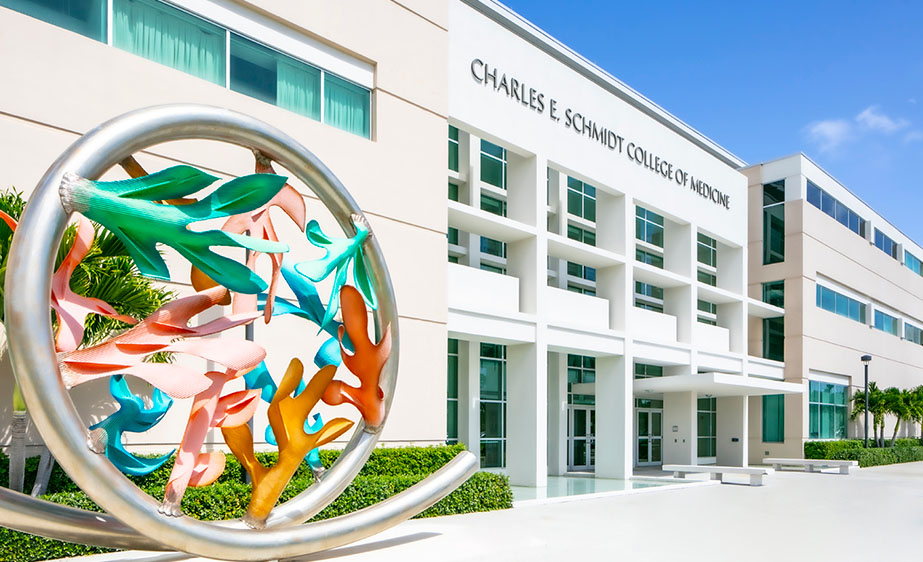
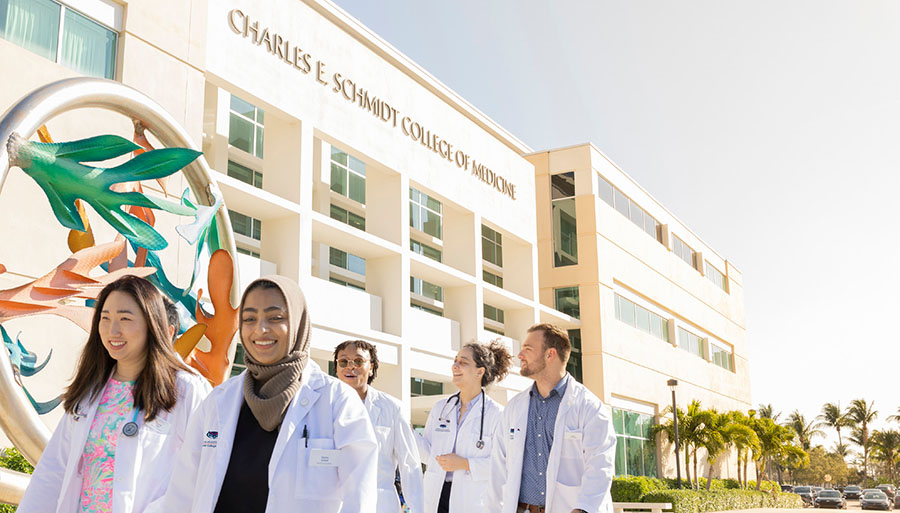
The Schmidt College of Medicine is one of the fastest-growing medical schools in the nation, we are committed to advancing excellence in education, research, clinical care, and community engagement. Nationally recognized by U.S. News & World Report, the Schmidt College of Medicine partners with more than 300 community organizations from Miami-Dade to Vero Beach, creating meaningful impact across South Florida.
Explore Our College
Strategic Plan

Life in Boca
Rankings and Facts
Helpful Resources & FAQs
Glossary of Terms
What Does That Mean? Starting a new role here can come with a lot of new terminology—some academic, some administrative, and some unique to our campus. This glossary is designed to help you get familiar with commonly used terms, acronyms, and phrases you may hear around the College of Medicine.
- AAMC
- Association of American Colleges
- ACCME
- The Accreditation Council for Continuing Medical Education; organization that reviews and accredits graduate medical education (residency and fellowship) programs, and the institutions that sponsor them, it is also the main accreditation body for CME courses
- AMCAS
- American Medical College Application Service
- CAPS
- Counseling and Psychological Services at Florida Atlantic University
- CDC
- Center for Disease Control and Prevention
- CIPEC
- Curriculum Integration and Program Evaluation Committee
- CLG
- Clinical Learning Group: a component of the Foundations of Medicine (FOM) course for year 1 and 2 students. These small group sessions provide a time for reflection and discussion of recent clinical experiences in their preceptors offices and with standardized patients; focus is oral case presentations, note writing, clinical reasoning, evidence based and patient centered practice, as well as integrating issues of ethics, cultural competency, geriatrics, and community advocacy.
- COM
- College of Medicine
- COMCC
- College of Medicine Curriculum Committee
- CSSC
- Clinical Skills Simulation Center; in Research Park at FAU; equipped with mannequins that are programmed with pulses, heart beats, and pupillary changes, can breathe, bleed, blink, and excrete fluids; provides the student an opportunity to practice, prepare, and analyze all aspects of the chain of patient care and treatment
- FAFSA
- Free Application for Federal Student Aid
- FBS
- Fundamentals of Biomedical Science: The course name for the integrated basic science courses in Fall semester of year 1 which includes anatomy along with other core basic science disciplines such as biochemistry, immunology, histology, etc.
- FCHS
- Family and Community Health Sciences: One of two six-month longitudinal integrated clerkships in year three that integrates clerkships in psychiatry, obstetrics, gynecology, and pediatrics
- FERPA
- Family Education Rights and Privacy Act
- FOM
- Foundations of Medicine: A three part, integrated patient-focused course that teaches students clinical skills longitudinally across years one and two.
- ICA
- Institutional competency assessment: Clinical assessment of students to measure acquired proficiency in clinical skills used during competency weeks.
- IM
- Internal Medicine Residency
- IPFC
- Integrated patient-focused curriculum
- IQ
- Injury Cases; refers to the format of problem-based small group cases used in the COM during Year 2 courses.
- LCME
- Liaison Committee for Medical Education: The accrediting authority for medical education programs leading to the MD degree in US and Canada.
- LIC
- Longitudinal Integrated Clerkship: third year integrated clerkship curriculum - core teaching sessions one afternoon a week plus hospital rotations and outpatient experience.
- M1, M2, M3, M4
- Used to describe first-year, second-year, third-year and fourth-year medical students.
- MCAT
- Medical College Admission Test
- Medical Student
- Refers to any person who is enrolled in or seeking an M.D. degree from the College of Medicine.
- Member of the University Community
- Refers to Trustees, students, faculty, staff and all visitors, contractors, and guests to the University or any of its campuses, facilities, or events.
- MSS
- Medical and Surgical Sciences: One of two six-month longitudinal integrated clerkships in year three that contains inpatient and outpatient experiences in Medicine, Critical Care, Surgery, Anesthesiology, Emergency Medicine, Pathology, Radiology, Geriatrics, and Palliative care.
- MSPE
- Medical Student Performance Evaluation; "Dean's Letter;" summary of student performance throughout medical school, prepared in fall of year 4 as part of the application for residency.
- MSPPSC
- Medical Student Promotions and Professional Standards Committee
- NIH
- National Institutes of Health, funds biomedical research conducted at the College of Medicine.
- Notice
- Used in the context of delivering a notification to someone. Official correspondence will be sent to the student's physical address on file with the registrar, or to the FAU email address if the student is a current student. The COM uses electronic mail to provide official information to students. Students are responsible for the content of University and COM communications sent to their FAU email account and are required to activate that account and check it regularly.
- NRMP
- National Resident Matching Program: The NRMP uses a mathematical algorithm to place applicants into residency and fellowship positions.
- NSB
- Neuroscience and Behavior: Year 1 course using an integrated approach by combining lectures, problem-based learning, and anatomy laboratory.
- OME
- Office of Medical Education
- OSA
- Office of Student Affairs
- OSCE
- Objective Structured Clinical Examination: A structured clinical standardized patient exam used to test clinical skills performance and competence.
- PBL/IQ
- Problem-based learning/Inquiry cases; small, student-directed, case-based learning groups in basic science courses in years one (PBL) and two (IQ).
- PCR
- Physicianship Commendation Report (PCR); A PCR is the mechanism for reporting a student professionalism commendation.
- PIR
- Physicianship Incident Report; a report submitted to the Senior Dean for Student Affairs; generated when a student's behavior raises some concern regarding his/her professional and ethical conduct; generally not as serious as those reported as a PEF
- PT1-4
- Pathophysiology and Therapeutics Courses in years 1 and 2: GI and Human Nutrition (PT1), Cardiovascular, Pulmonary, Related Hematology (PT2), Renal, Endocrine, and Reproductive Systems (PT3), Immunologic, Hematologic, Infectious Disease (PT4).
- SACS
- The Southern Associate of Colleges and Schools Commission on Colleges is the regional body for the accreditation of degree-granting higher education institutions in the Southern states. It serves as the common denominator of shared values and practices among the diverse institutions in Alabama, Florida, Georgia, Kentucky, Louisiana, Mississippi, North Carolina, South Carolina, Tennessee, Texas, Virginia, and Latin America and other international sites approved by the Commission that award associate, baccalaureate, master's or doctoral degrees. The Commission also accepts applications from other international institutions of higher education.
- SADSAA
- Senior Associate Dean for Student Affairs and Admissions
- S&T
- Synthesis and Transition: A two-week course at the beginning of year 3 that focuses on differential diagnosis, treatment decisions, and integrated simulation sessions as students prepare for their clerkships.
- SCP
- Science of Clinical Practice: a component of the Foundations of Medicine (FOM) course for year 1 and 2 students. These small group sessions provide a time for reflection and discussion of physicianship and doctoring topics including difficult conversations, ethics, cultural competency, geriatrics, and public health, as well as time to practice humanistic communication.
- SCRC
- Student Competency Review Committee
- SHS
- Student Health Services at Florida Atlantic University
- SP
- Standardized patient: professional patient used during OSCEs, ICAs, and clinical teaching sessions.
- UME
- Undergraduate Medical Education
- USMLE
- The United States Medical Licensing Examination: A multi-part examination for medical licensure; students must pass Step 1 and Step 2 (both Clinical Knowledge- Step 2 CK and Clinical Skills- Step 2 CS) to promote and graduate from medical school.